
Yard (2021)

Basic Information
Name: Yard
Built by: George Barrier in October 2021
Size: Three 4ft x 24″ plus two 3ft outside corners
Introduction
“Yard” is very ambitious five NTrak module set George built. The design of the yard fully embraces the NTrak concept by allowing them to be connected in any combination. The only restrictions are that there be at least one end included. The electronics support electrical isolation to occur between any two modules, allowing the yard to be placed near the club’s lift bridge. The inclusion of a corner allows placement anywhere in the layout, even wrapping around a corner..
Construction

The Roadbed
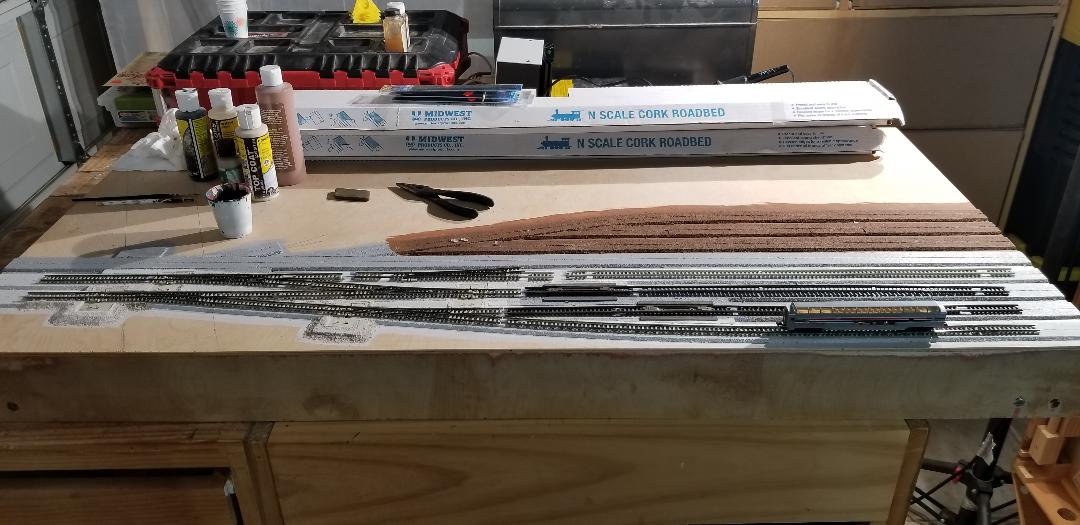
The first two tables are built and roadbed is glued on. The roadbed is painted in roughly the ballast color that will be added later. It is obvious from this progress that the yard set will require a lot of materials!
The Full Set
The tables for all five pieces are built. Only one corner is missing roadbed. Track is laid on one of the corners. Some loose pieces of track are set out to show the track complexity to come.

Module Upgrades 2022

The Ballast Begins
Once the first turnout is glued down, track ballast is added to give a glimpse of the final result. Each railroad tie is painted a slightly different color in a variety of patterns. This gives the illusion that some ties are more worn than the others, but this detail requires a massive amount of effort.
The West End Track Plan
About half of the turnouts are installed into this end of the yard. The tracks are numbered 1 through 8 starting at the outside (front) track. Track 1 is where the red main line passes through the yard. Tracks 2 and 3 will be dressed as passenger terminal sidings. The transportation terminal will be located on the center module. Track 4 is where the yellow main line passes through the yard. The crossover from yellow to red enables track 3 to be assigned to yellow instead of red. There is another crossover from yellow to blue for a similar purpose. These crossovers are located toward the center between the red and blue yard ladders. This location enables tracks 1 to 8 to be designated RRRYBBBB, RRYYBBBB, RRRYYBBB, or RRYYYBBB.

Controlling the Operation
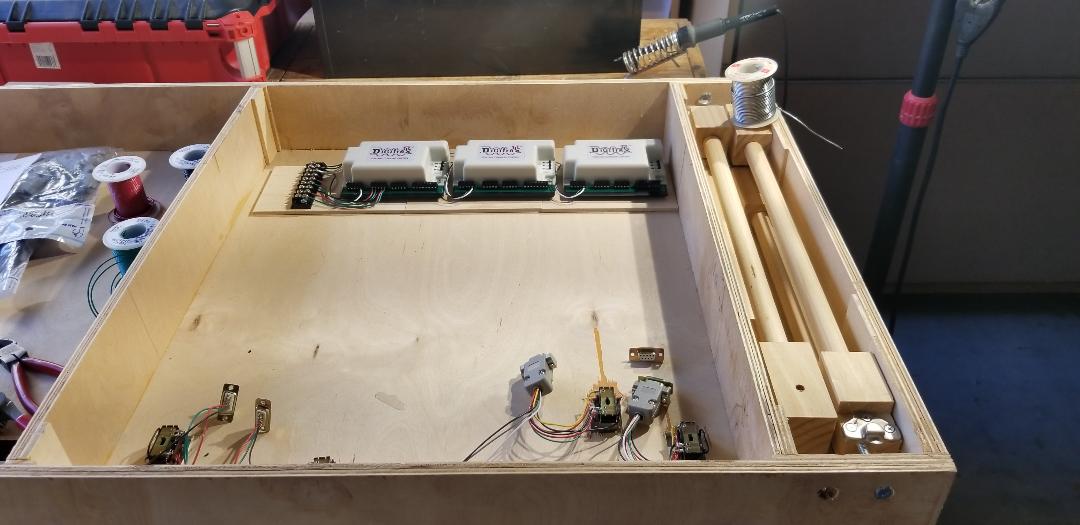
The West end of the yard needs 3x Digitrax DS64 modules to control the 11x turnouts on the module. Each PECO turnout has a PECO solenoid to pull the points each direction. The DS64 is strong enough to throw the PECO turnout easily.
These yard modules are designed to fold the legs double underneath the ends. The only thing above them on top of the layout is the joiner tracks.
Controlling the East end
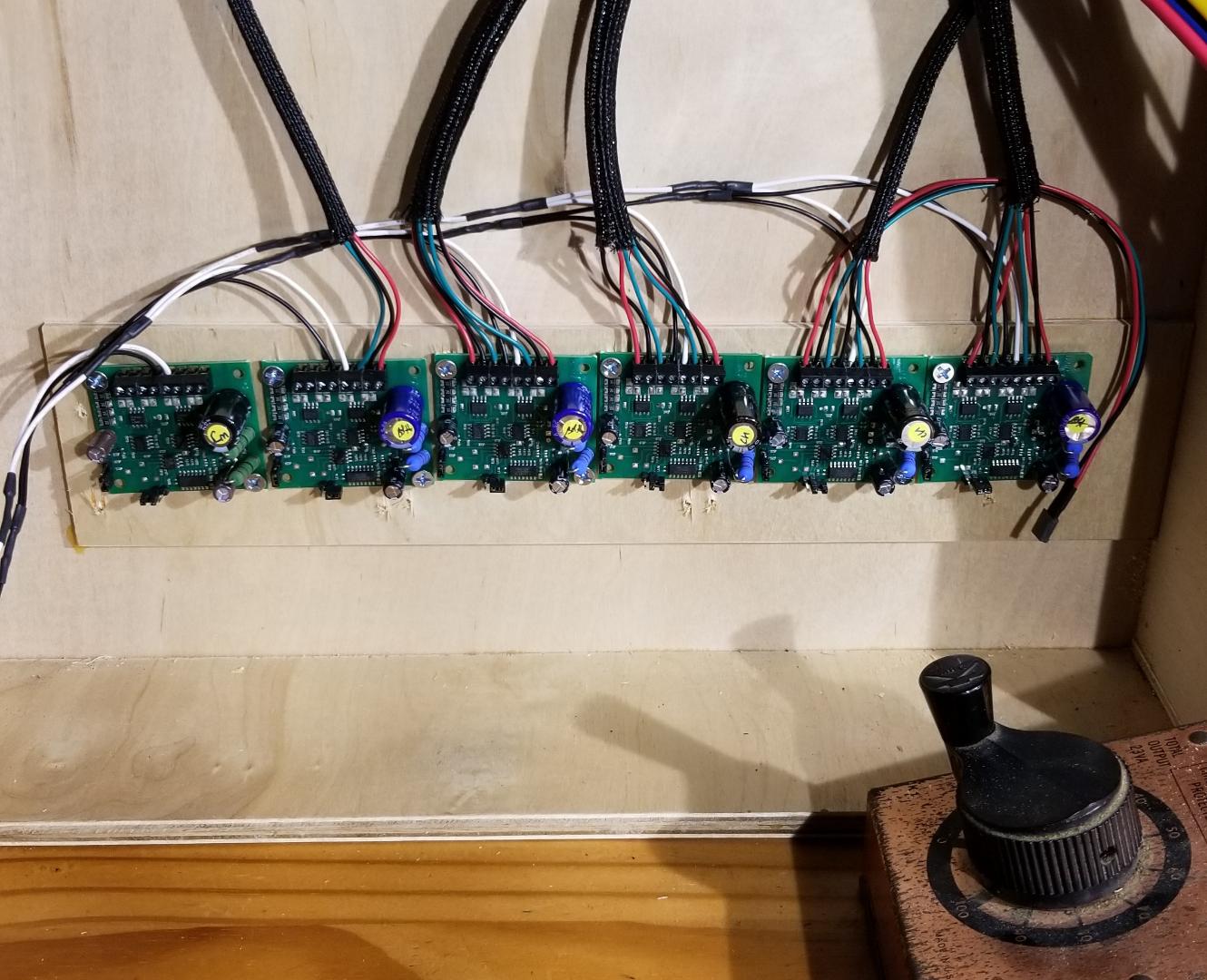
When I looked for more Digitrax DS64 modules, I discovered that Digitrax stopped making DS64 modules. The new DS74 are not strong enough to throw a PECO turnout, so I opted for the older DS52 modules.
So many turnouts!
The west end module is well under way. Half of the turnouts are in and working. Extra time is needed to make sure the tracks rests on the roadbed correctly. It turns out that the PECO turnout ties are slightly thicker than the Atlas flex track ties. Inserting a very thin strip of Plastrux under the Atlas track fixes this problem well. If the turnouts become humps, the trains will derail going through the yard.
Details to the Nth degree
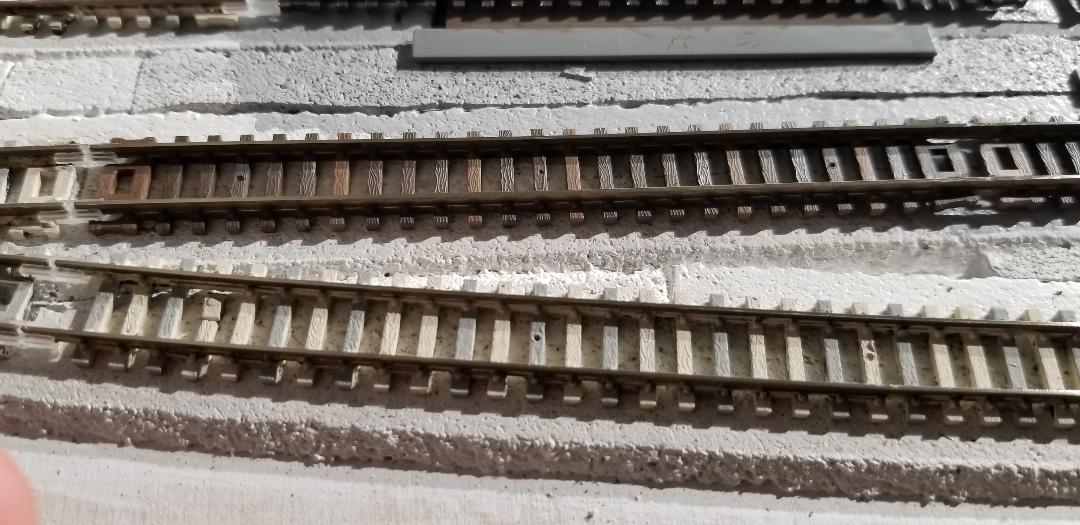
Each section of track in the Yard has a purpose and history. The “red” and “yellow” main lines have been recently re-laid, hence their newer appearance. To carry the heavier traffic, concrete ties were used for these two tracks (#1 and #4) Three different colors were mixed to paint the ties. A relatively random pattern was used to select the color for each tie, trying not to put the darkest and lightest color adjacent to each other. White marble ballast was used for these tracks.
The passenger sidings (#2 and #3) are laid with relatively new wooden ties. Again, three wooden colors were mixed to paint these ties. Painting each tie a different color was one of my more questionable decisions. I am glad it is all done.
Insulated rail joiners were used on both rails where the tracks connect to the turnouts. This allows the power for each track to be shut off completely, supporting DC operation.
Module Upgrades 2023
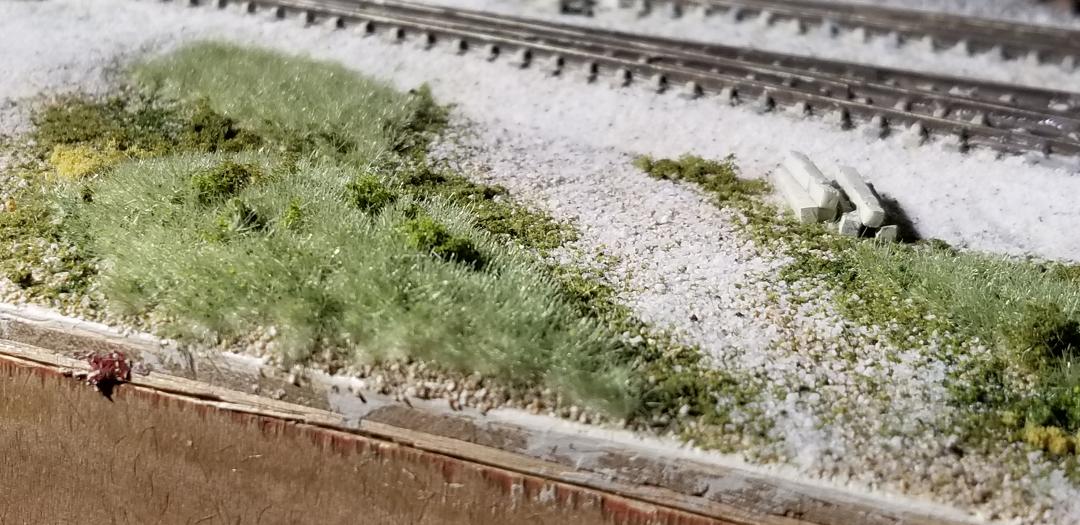
Scenery makes the scene!
Ten different Woodland Scenic products (including glue) were used to layer-up the little splash of green in front of the tracks. Using many different sizes and colors provides a rich variety in the appearance. Under all the foams was applied some patches of static flock grass. Even this is a mix of different colored materials so the patches of grass do not all look the same. This turned out to be my best scenery work to date!
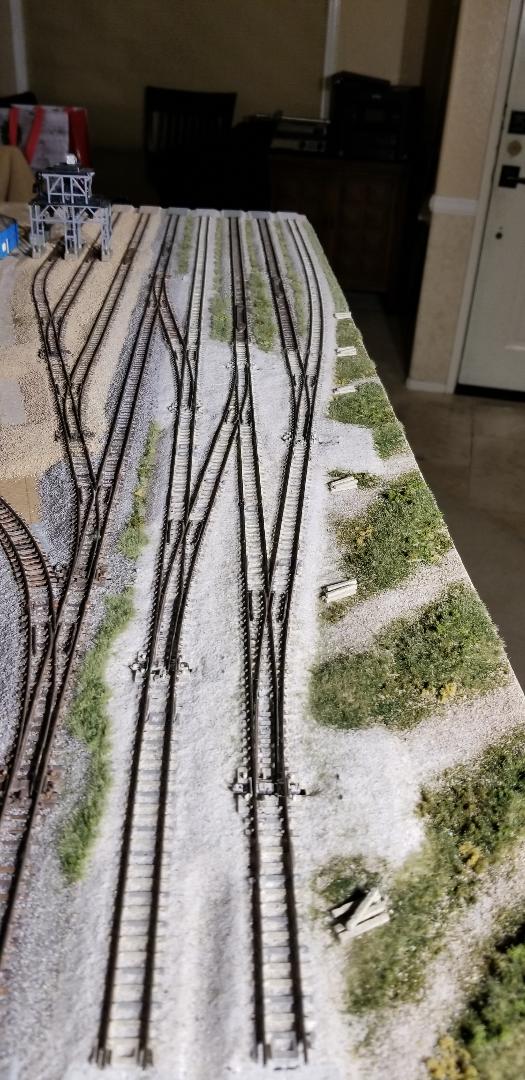
All the turnouts are in
All the ballast is finished for the eight yard tracks. The weedy area in front of track #1 looks so good, that I decided to put some weeds between the tracks as well. Stacks of concrete ties are placed on the shoulder of track #1. These are leftover materials which will be collected later by the maintenance-of-way crew.
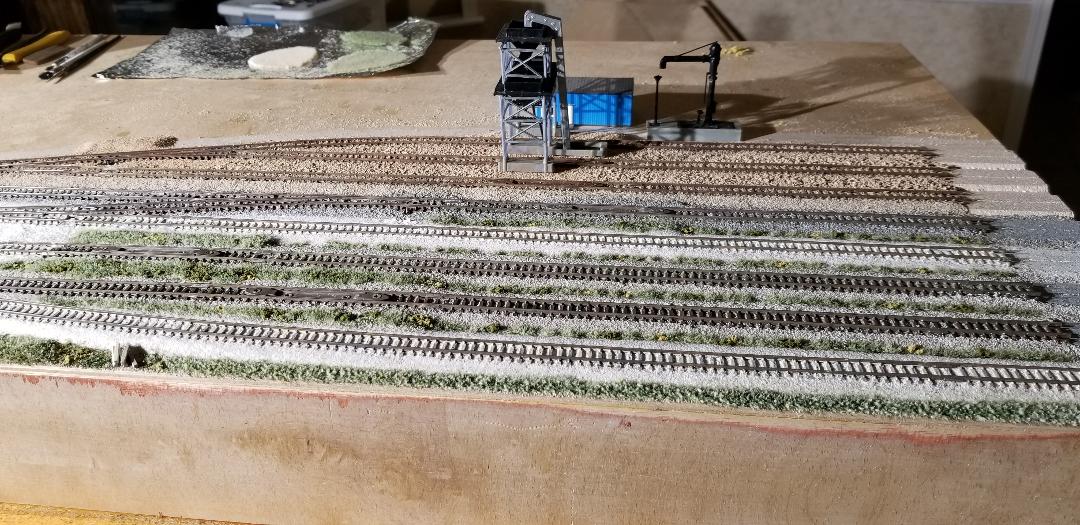
Brainstorming some structures
With the eight main level tracks complete with scenery, a few buildings are set in place to see what a small engine service center would look like. A coaling tower and a water spigot along with a service shed is looking pretty good here. The West End “blue” yard tracks will house a steam locomotive service station.
Track block controls
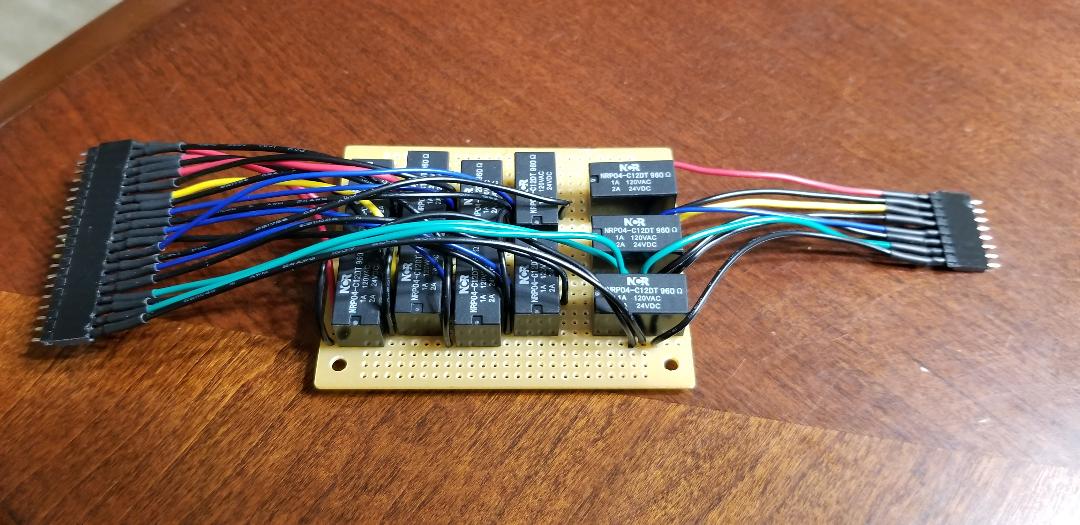
A small PCB is used to build the relay cluster for the West end. The eight relays on the left can disconnect the power to each yard track individually. The three relays on the right select which track bus (red or yellow) powers track #3, which track bus (blue or yellow) powers track #5, and which track bus (blue or green) powers the ramps in the back. Another one of these is built for the east end. Eventually each module will have one of these.
The West end is wired
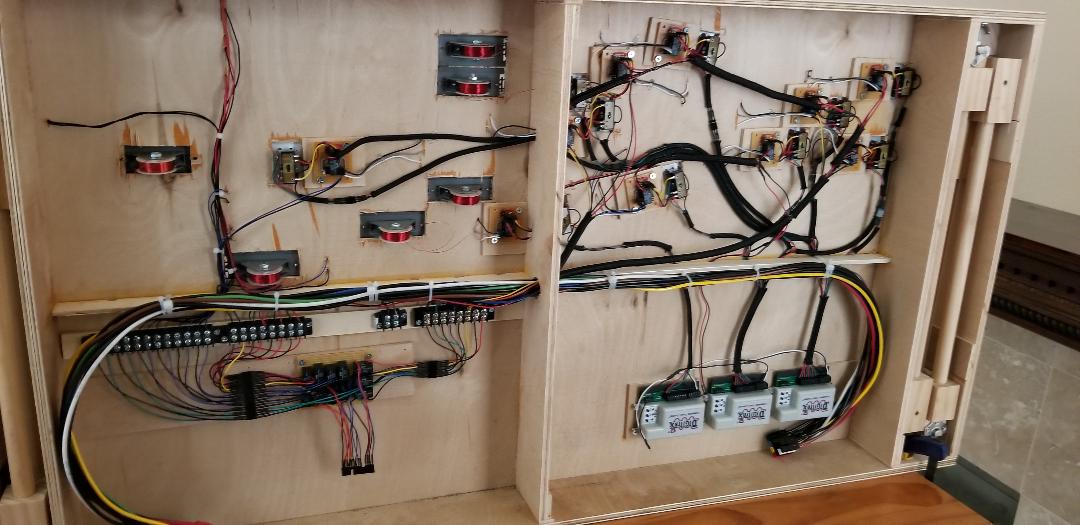
The bottom of the west end is getting pretty busy. Each turnout has a relay to select which turnout rail powers the frog. Since all turnouts are electro-frog, an accessory switch is piggyback to each turnout motor. The relays protect the accessory switches from excessive currents when locomotives are passing through. It will be hard to find more space to connect the un-coupling magnets. This is a problem for another day. It is good to not tackle the whole project at once, but to get some basic stuff working first.
Ready for the show!
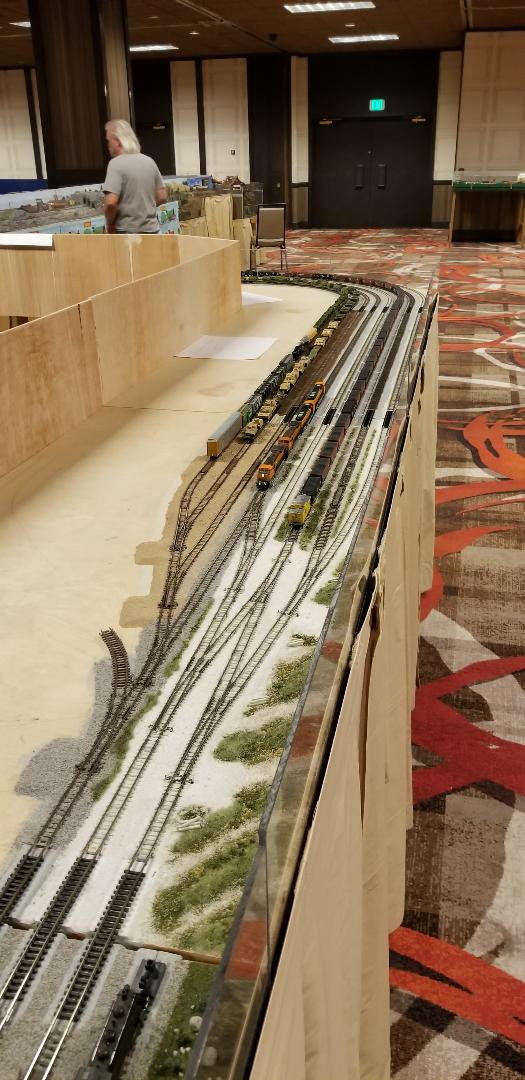
Even though the yard modules are not complete, they work well enough for the show in Reno. We made good use of the yard tracks as guests to the convention were allowed to run trains on our layout. More work is needed for sure, but that will wait.
Module Upgrades 2025
The rear tracks
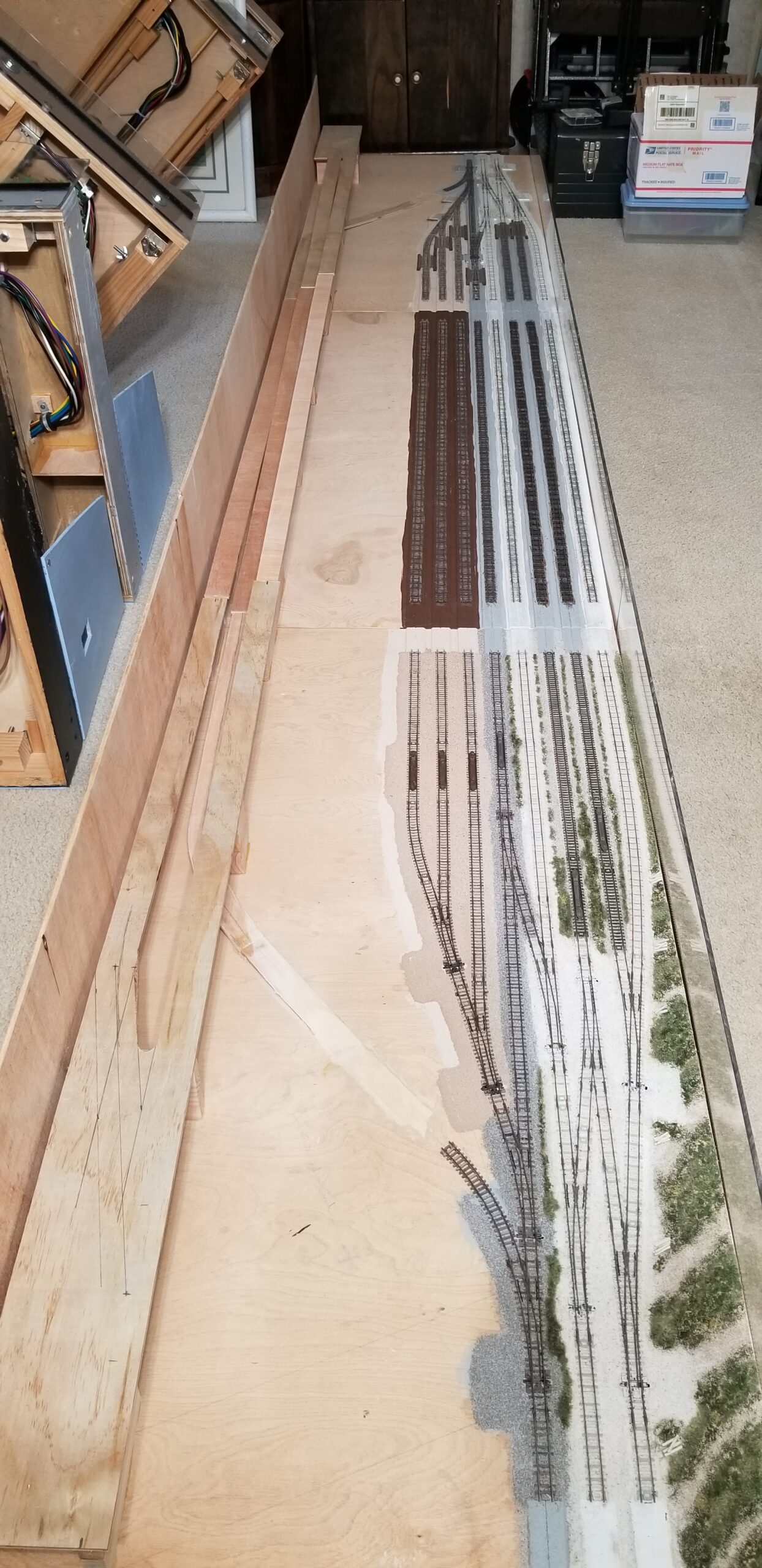
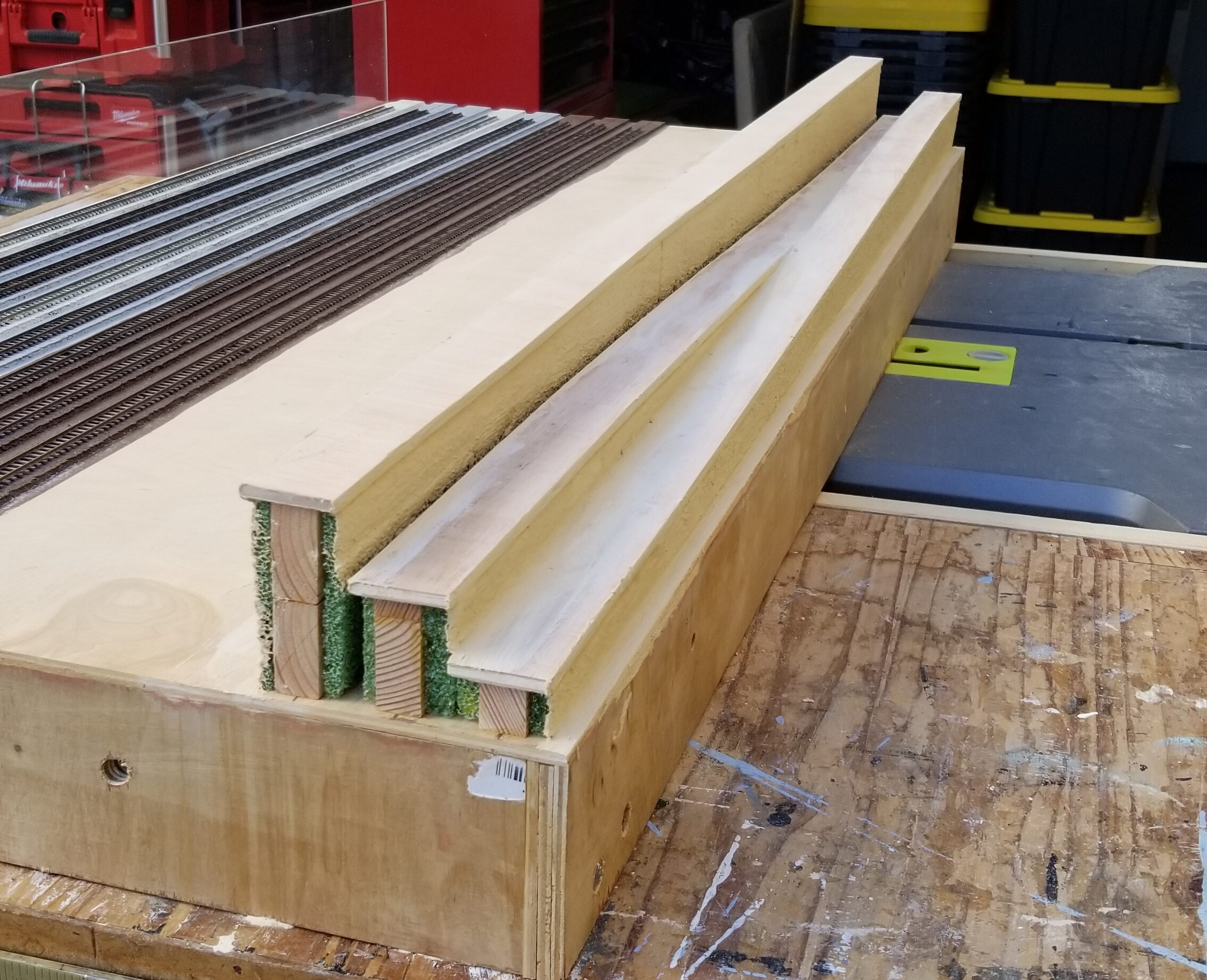
The Yard modules will have a “green” track elevated at 3 1/8in above the others. The city buildings will be at this height. It will be the main level of the city. Spur tracks from the “green” line will service city businesses. Behind the “green” line, there will be a ramp connecting the “green” to “blue” in both directions. The rear-most track descends from west to east. The middle track descends from east to west. The front track stays at the “green” level. At this stage, only the plywood sheets are in place to support these rear tracks.
Supporting the supports
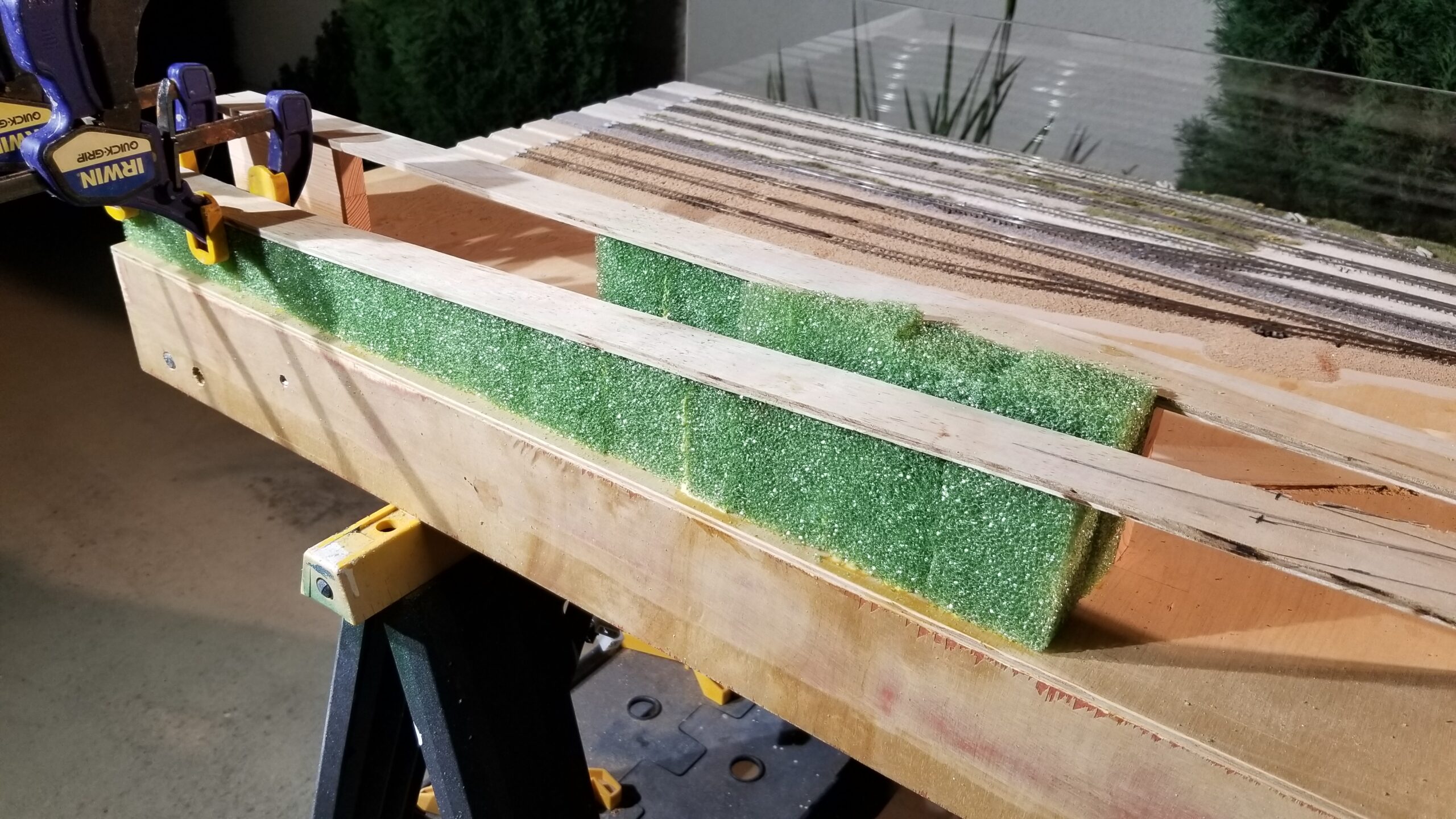
To reduce weight, the plywood strips are firmly attached only at the edges. The middle part is stuffed with floral foam to keep the strips from sagging in the middle. These foam blocks are carefully cut with a Dremel vibrating cutting blade.
Plastic Wood
The floral foam is coated with a thin layer of Plastic Wood. This provides a very hard shell to an otherwise very brittle material. A small gap is left behind the “green” line to allow room to insert building flats later.
Getting a good grade
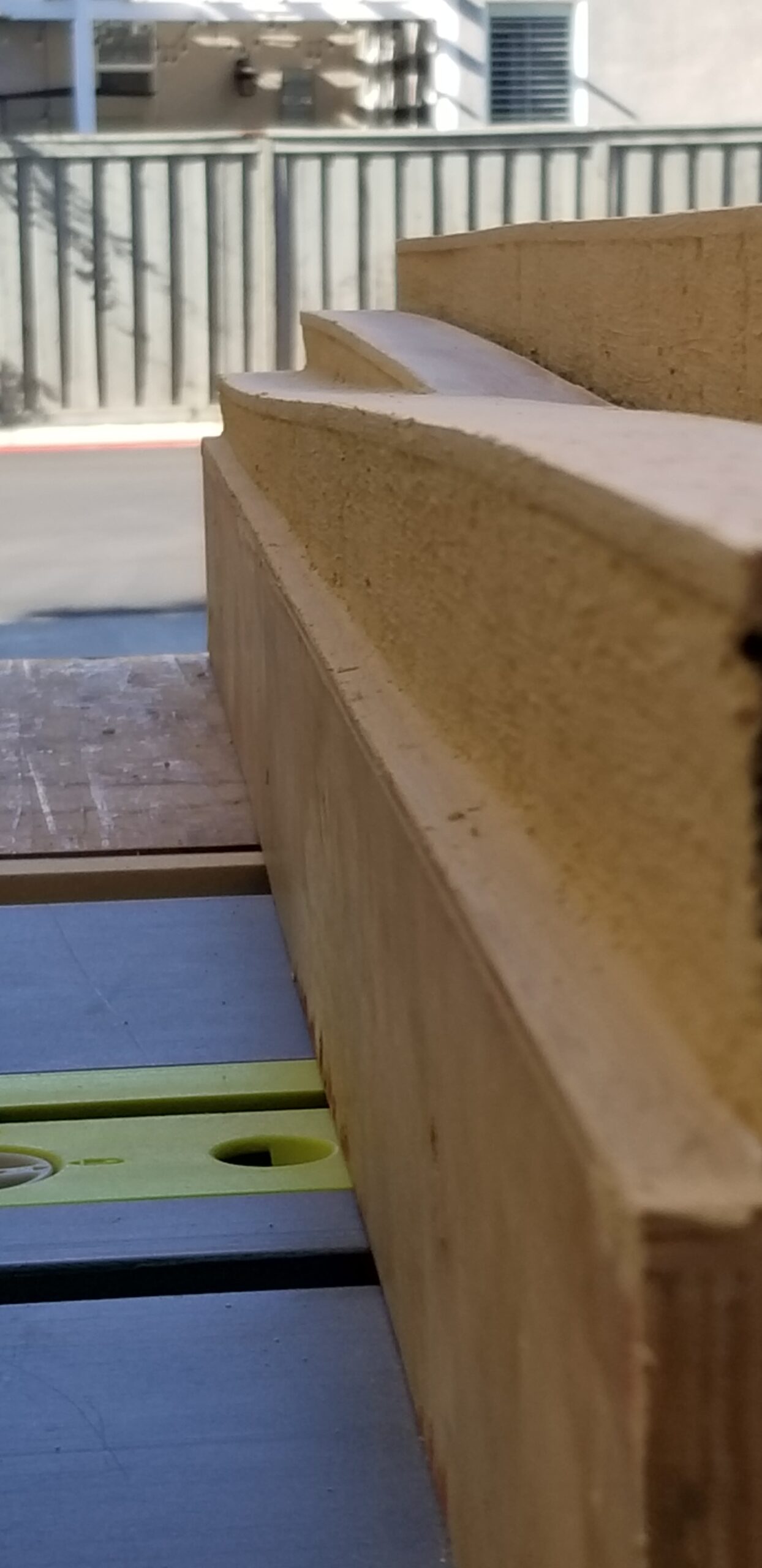
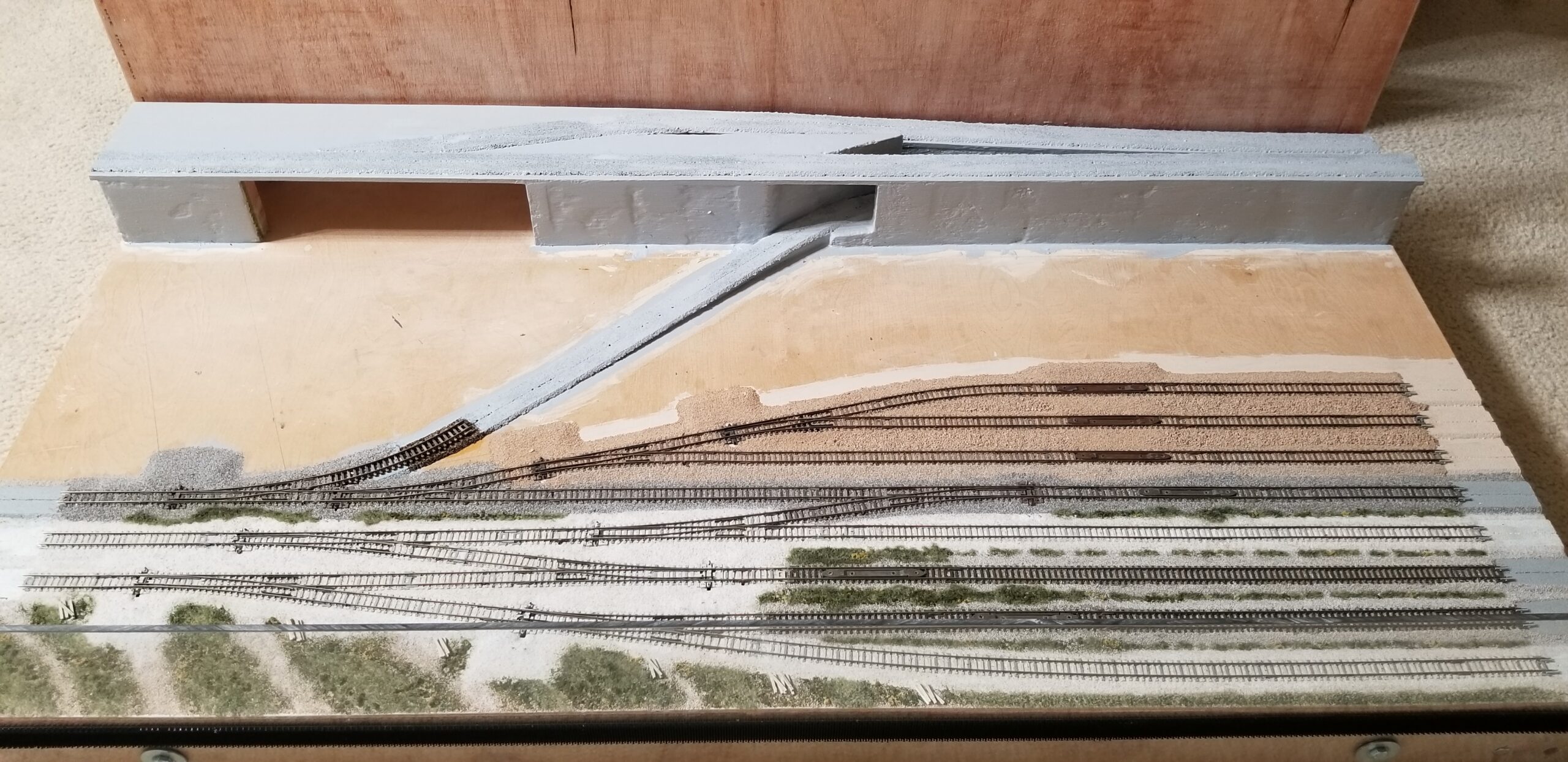
The yard corners do not have a slope to the ramp tracks, therefore all connections between modules must be at a level grade. Each module raises or lowers the elevation of the ramp by 1in. The plywood strips are bent so that the changes in grade a gradual with the steepest grade briefly in the center. This minimizes the stress on the couplers. Sudden grade changes can cause train cars to de-couple accidentally.
Connecting the ramp
Years ago, a mysterious turnout was added going absolutely nowhere. Finally, this orphaned turnout actually connects to something. The grey paint improves the appearance of the raw material. There is a show fast approaching.
The show must go on
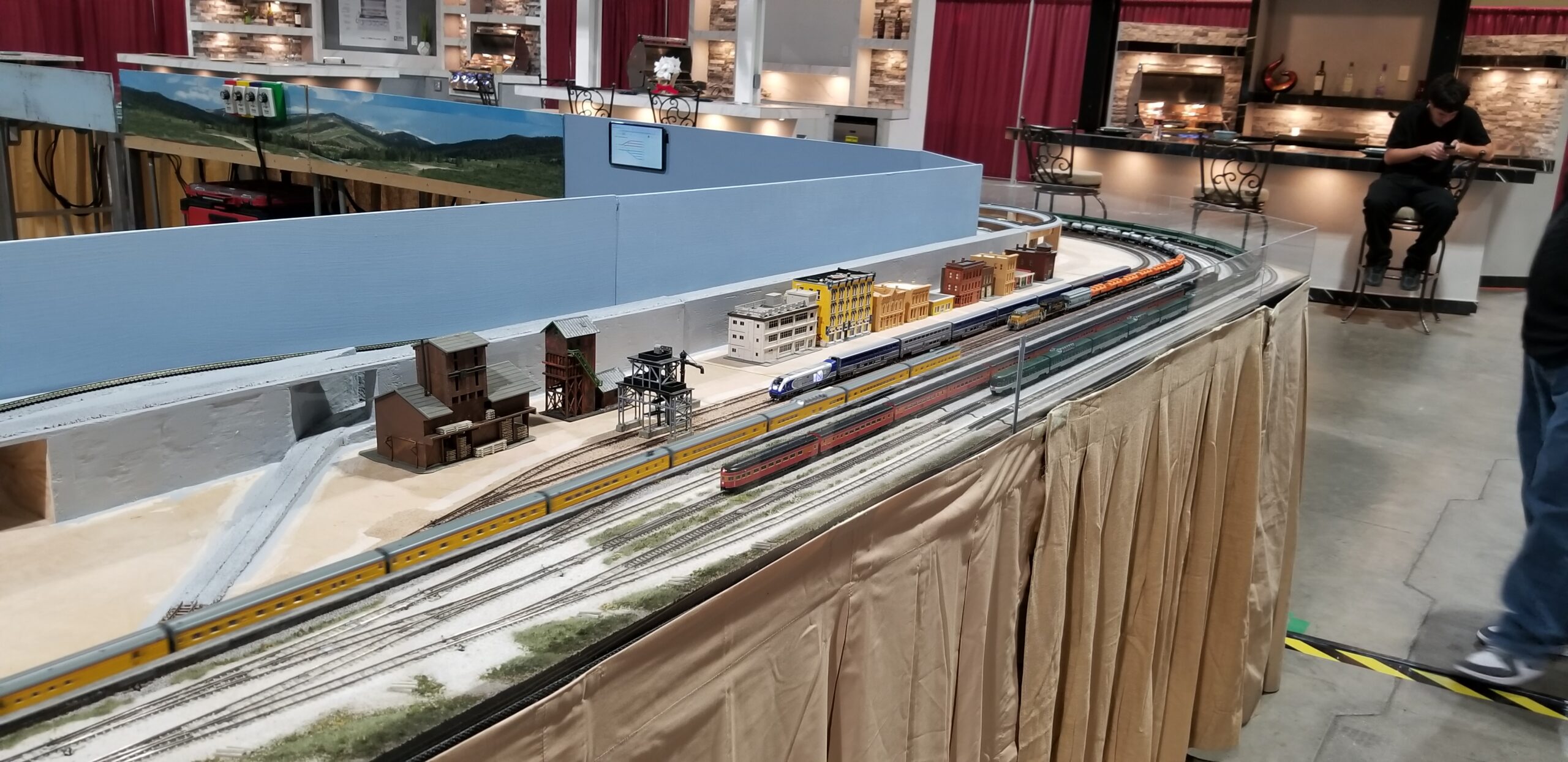
Even though the yard modules are not 100% complete, they are still functional enough for a show. The track is installed for the ramp rising from east to west. To the west of the yard, the “green” line connects to the oil refinery, the campground corner, and the Sodor modules. Trains were run up and down this ramp all the way to the other end of Sodor (10 modules!).
Behind the skyboard, two tablet computers were attached (one at each end of the yard). These touchscreen tablets allowed club members to operate the yard by throwing and closing the turnouts. The control panels are designed to resemble the track plan, so no knowledge of the turnout ID codes is required.
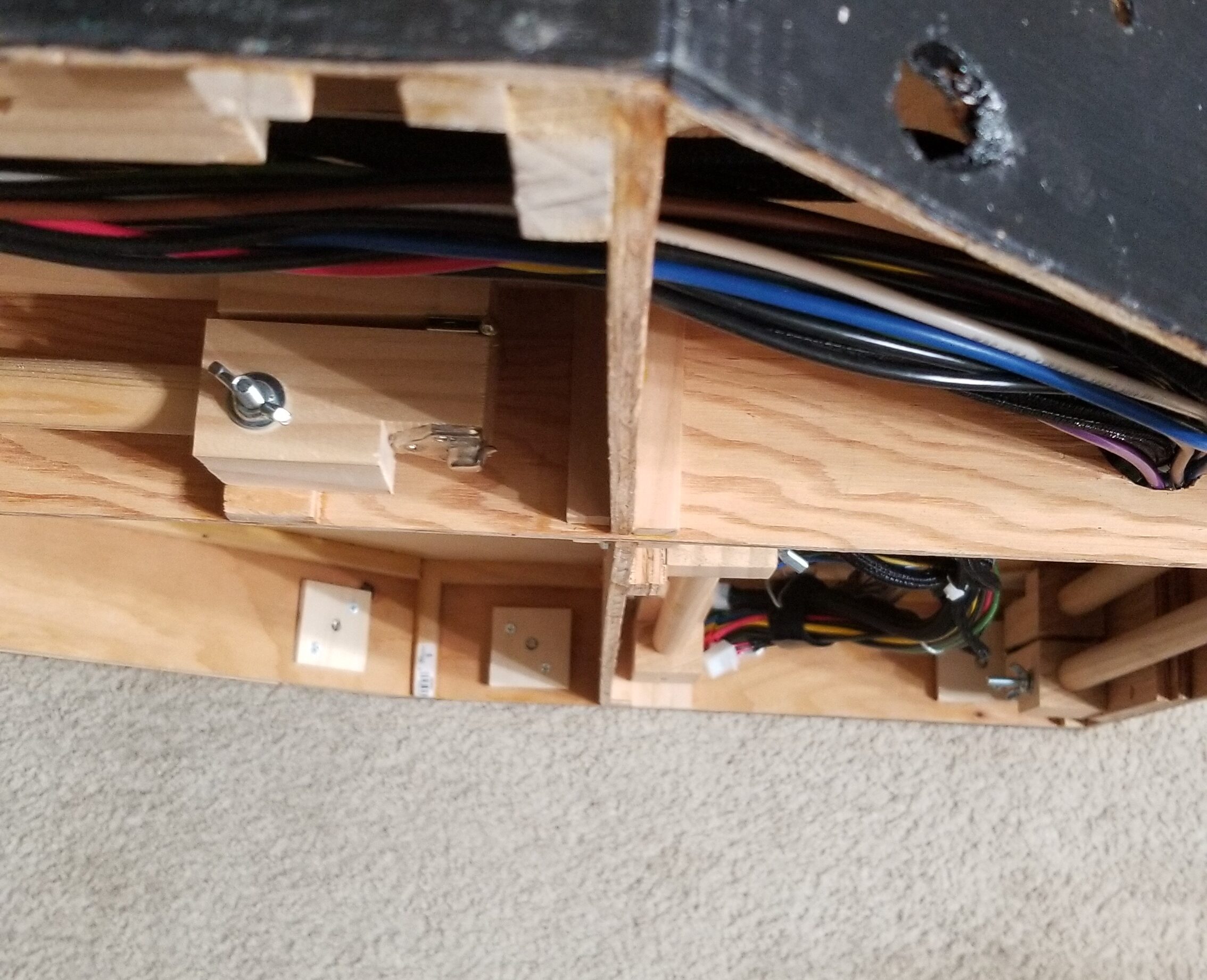
Something is not right
While setting up the layout, the modules did not quite connect in a ring like they should. The straight modules should be straight and the corner modules should have right angles. It turns out that the yard corner is not exactly 90 degrees. A small construction error caused the corner to be slightly less than 90deg, maybe 89deg or 88deg. A quick inspection of the bottom of the module reveals the mistake clearly.
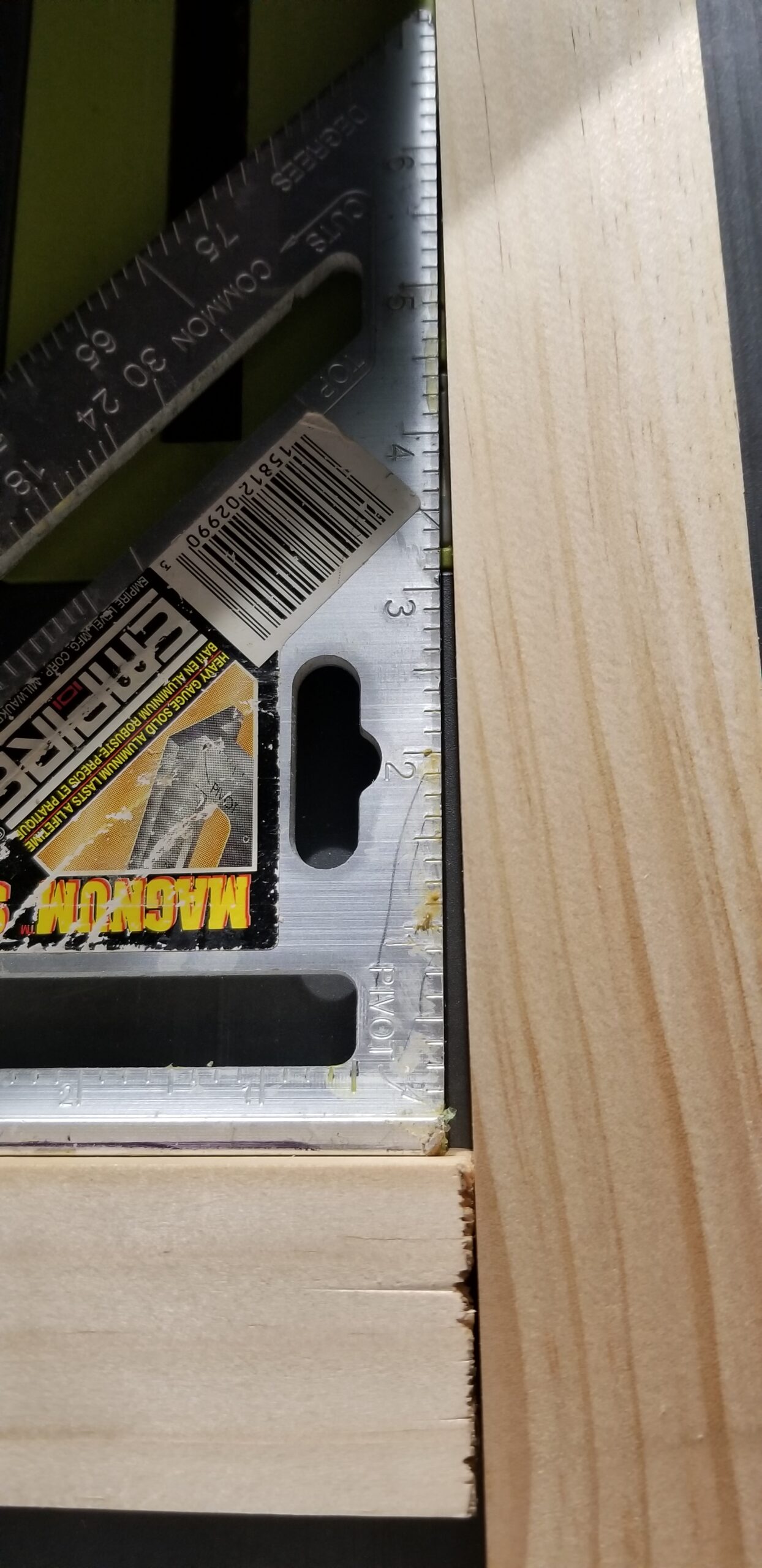
Found the problem
Projecting the sides of the corner module to a point, then comparing it to a carpenter’s square diagnoses the problem using science. One of the sides must be adjusted. Extra material was glued to one side, then carefully sanded to give the desired angle. The corner might be 3ft minus 1/8in now, but the angle is more critical. Of course, the tracks had to be trimmed a smidge as well as the shyboard.
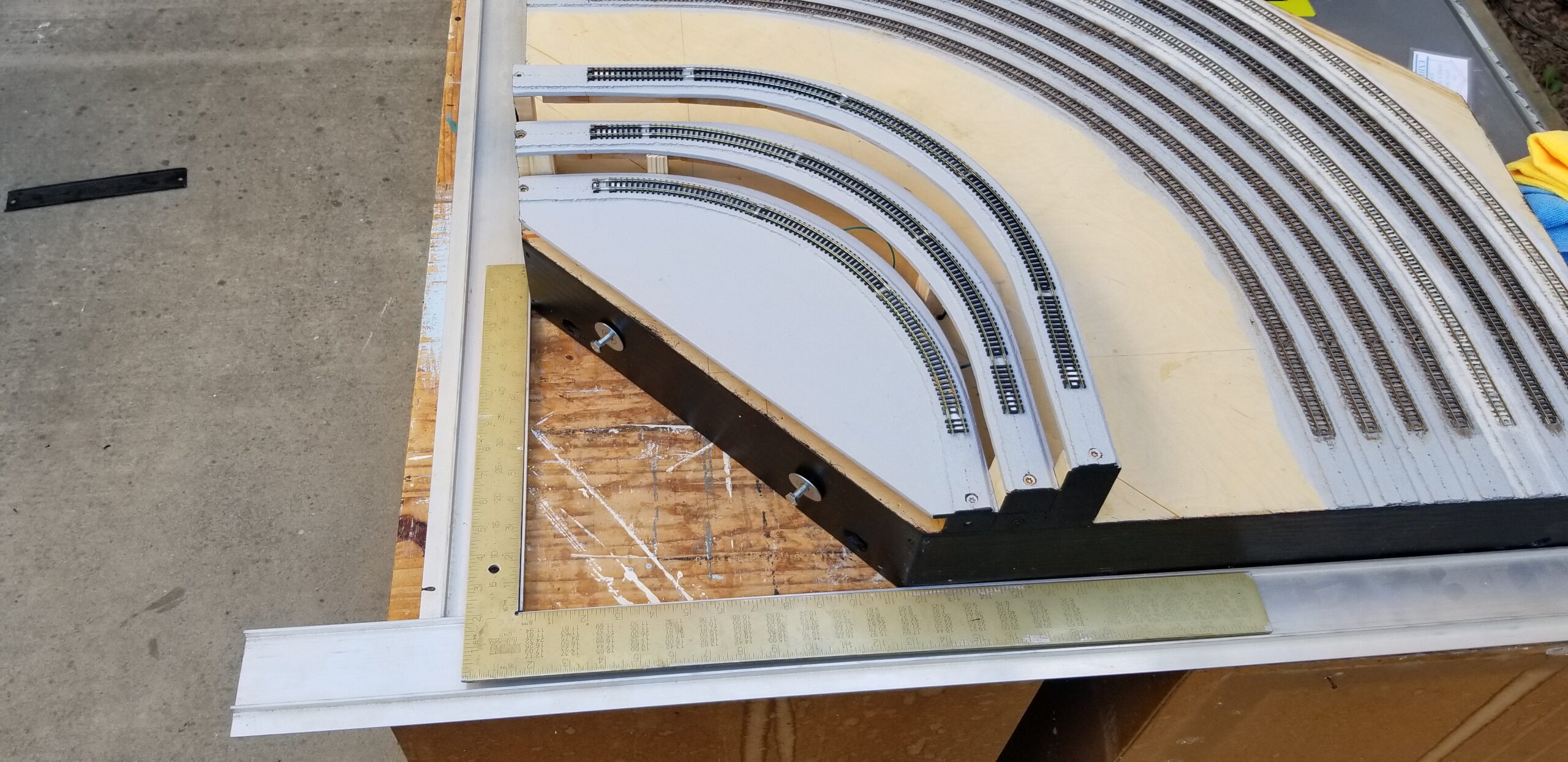
All better now
Science proves that the yard corner is now exactly 90 degrees. There will be no more problems during setup from this issue.
Module Upgrades 2026
Some more space
Recent experiences with the Oil Refinery module showed that the delicate electronics under these complex modules should be protected from damage during transportation. Installing these hinged panels offer that protection while also adding a lot more space to mount electronics.
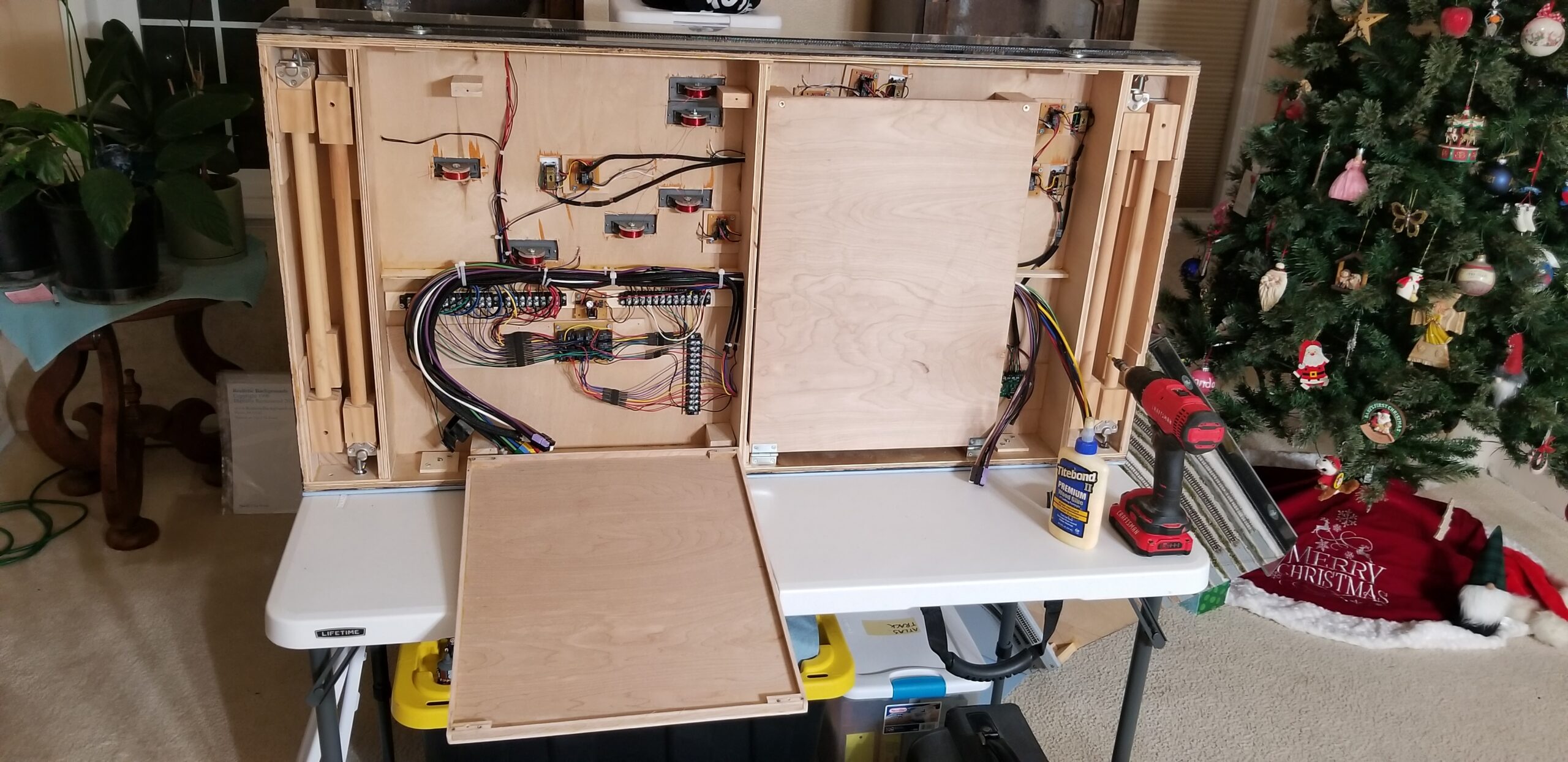
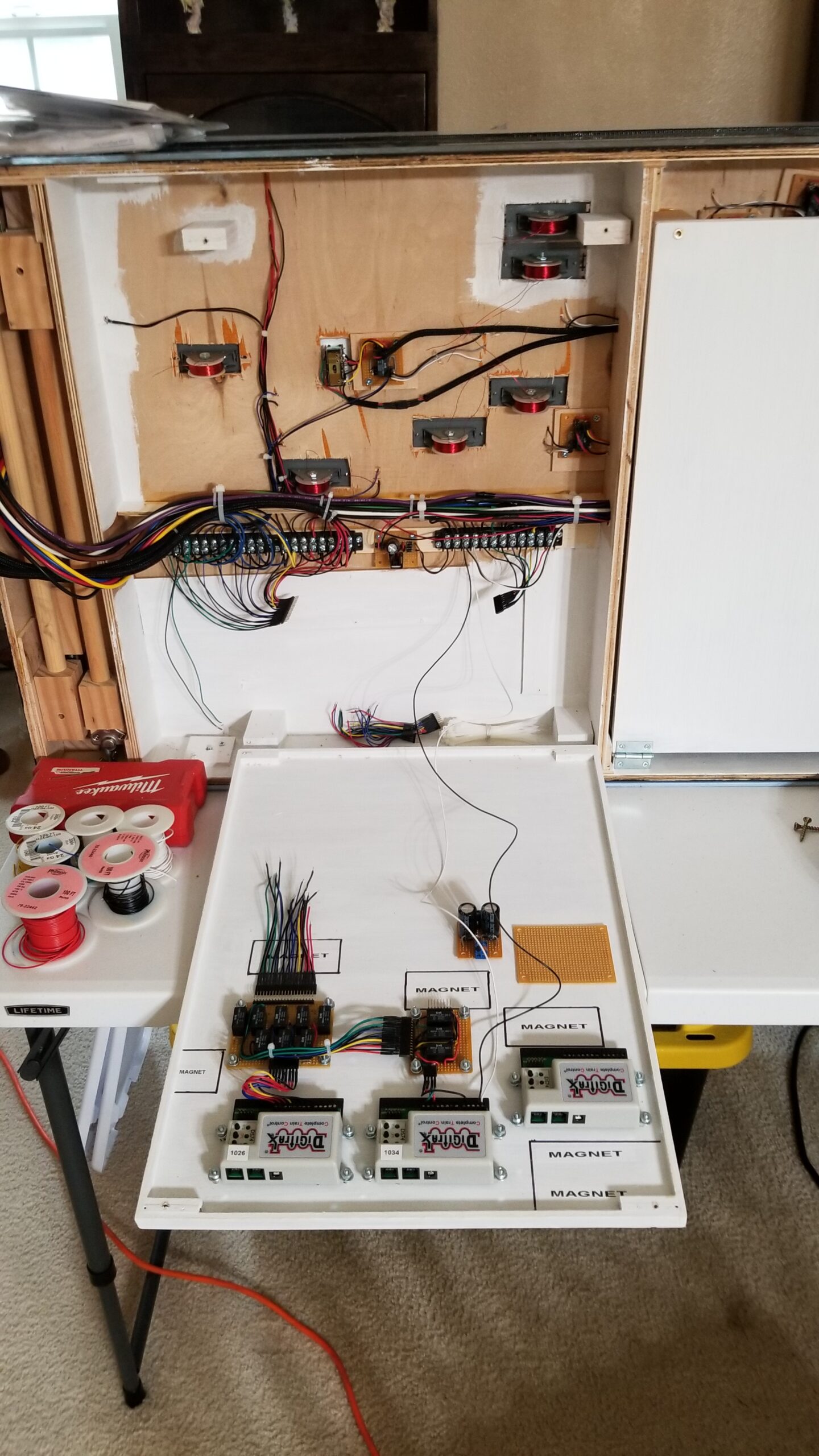
Track block power
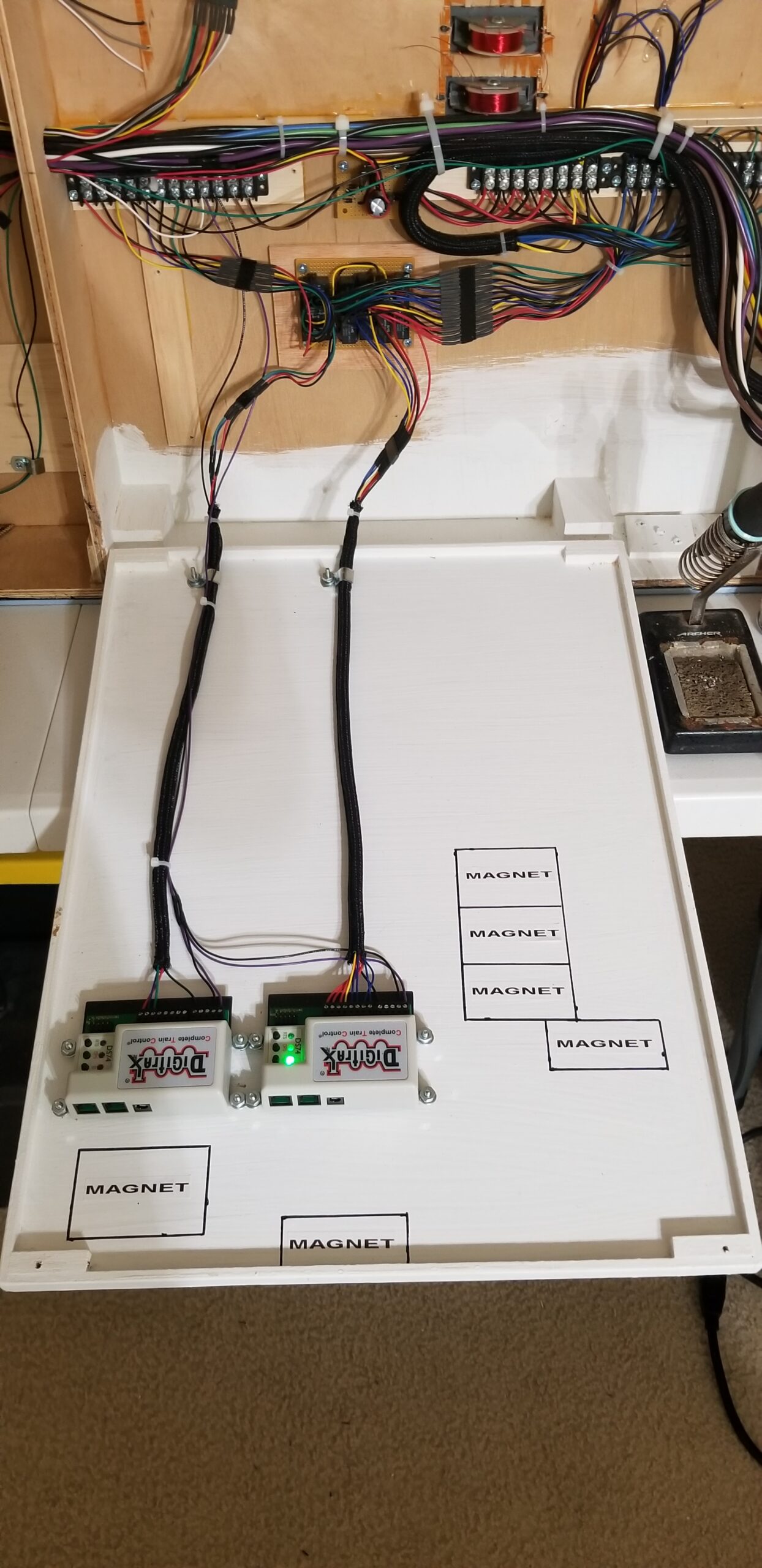
The wiring for the track power and bus selection are now controlled by the computer system. Buttons for these are added to the control panels.
Anything you can do…
The east end of the yard also gets controls for the track power and bus selection. Sometimes the yard is placed close to the lift bridge and the power must be cut to some of the yard. Having a set of controls at each end supports this function. When the bridge goes up, the trains shut down!
More track ballast
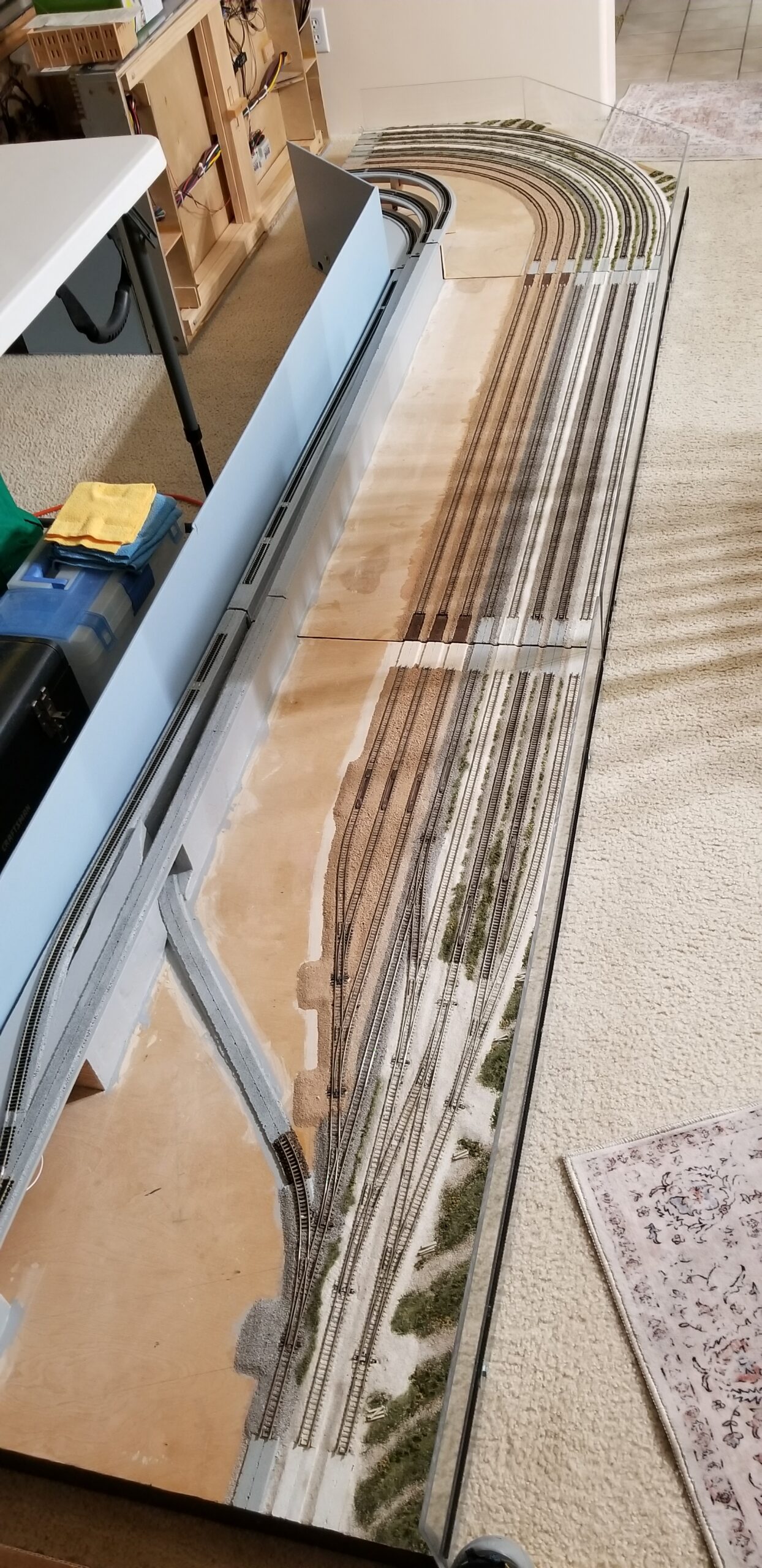
Three other yard modules now have track ballast. The yard corner has some weeds and stuff like the west end.